May 25, 2006

Drive Innova, Drink Coke, Ban Aamir

Binu Alex

Whenever I listen to Pankaj Udhas, I appreciate him for his permutations and combinations of words that he uses to admire alcohol. Whatever tunes that he uses, whatever occasion he may be in, he has nothing but alcohol. He uses liquor statements even to express love. For me he is the biggest ambassador of liquor companies in Devnagari language.

But I don’t know him personally and so I am not sure whether he pours this admiration into a glass, adore it with some soda and then consumes it at the same frequency that he sings songs for it.
This is the same formula that works for Gujarat. This is a state full of contradictions. As soon as you complete your words about the post earthquake resilience of the people here, you have a Godhra and post Godhra. No sooner you finish speaking how people have bounced back from this violence; you have Narmada oustees left in the lurch because they are the most vulnerable and most unwanted tribal people of the state. As you finish speaking about how the state has still emerged as number one destination in industrial investment, you have Vadodara violence. And as you admire the way the city has normalized, there are some fanatics who have banned Aamir Khan.
I am the biggest causality of these contradictions because each time I start praising the place, it falls right on my face.
The best part of all these drama is that common people are just not concerned. “There must have been some reason if riots have taken place in Vadodara,” my neighbour, a Patel running a chemist shop told me the other day. He repeated this to Aamir Khan ban as well. But what surprised him was a resolution passed by Chemists Association to boycott all products endorsed by Aamir Khan.
To my memory, he hasn’t endorsed any product that has a remote relation to chemists and druggists. Two of the advertisements that I see Aamir Khan in a television commercial are for Coke and Innova. Innova is not sold through a chemists shop and these same chemists haven’t stopped selling Coke.
So what are these bans all about? Anyone can interpret this as a political sycophancy. It was the same sycophancy to impress the Chief Minister that many associations sang the same song during the Narmada issue. How does this benefit these associations? Immense, according to one of the political analysts. People hang on as association presidents and secretaries mainly for political ambition. Political ambition also means monetary benefits. People may believe they are devoted Hindus. As Ganesh Devy pointed out in one of his commentaries in Tehelka Magazine, the “Gujarati devotion is all about acquiring. They have an exchange relationship with God - I give you devotion, you give me riches.”
It is the Pankaj Udhas story again. You give me a tune, I give you the same devotion again and again.
I had a few Muslim friends when I was in School. I tried to contact them after the riots. Though they did pick up the phone, they did not care to give back a call though I had given my full address to them in case of any need. I called them again this year. Two of them have gone to Middle East and a few who are left here were apprehensive. Though they asked me about my well being, I could overhear the murmur “leave us alone”.
So that is the reason you a long list of NGOs fighting for Muslims who have nothing to do with Islam. Because what happened was a human rights violation, human rights activists are there in the scenario. Because a huge rehabilitation is necessary, you have a long list of NGOs even in that line. And not to forget a number of agents for funding agencies who dole out funds to nondescript NGOs for what they term as developmental work. But I don’t see any Muslims in the scenario. This also indicates how politically isolated the Muslims are in Gujarat.
I really pity the people who issues diktats to ban those people who speak against the state. In a democracy, it is the right of a citizen to express what he feels right or wrong, even if it against the policies of a state. But because you are pro-Narmada, you are against anyone who speaks for the project affected people. Are we a banana republic? Yes, to a certain extent we are. You need not be an expert to know that all these are political actions and have only political answers. You cannot expect a solution from civil society to these problems. My only question is how long will this primitiveness continue? Till that time let the sharab ka nasha continue.

ba

April 18, 2006

Narmade Sarvade


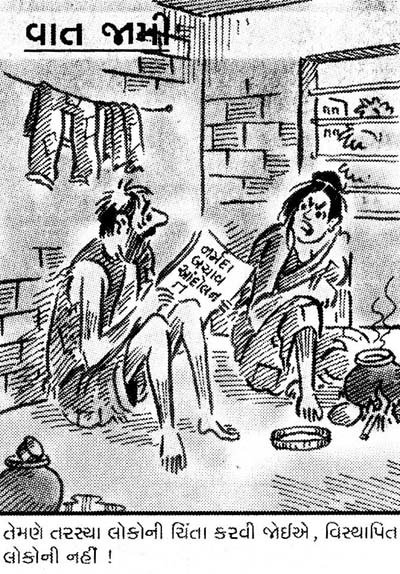
This cartoon that appeared in the Gujarati vernacular daily on 18 April, 2006 is a reminder of the emotions that an average Gujarati associates himself with Narmada.
As I was walking out of an assignment with a high profile businessman, he stopped me to ask what my opinion on the anti-Narmada protests were. He later told me that the question was primarily because the English media has generally acted against interests of Gujarat and was keen to know what I felt. In Gujarat it is normal to face such barrages of questions and so I was not surprised. But what surprised him was a condition that I posed to him before responding to his query. He agreed and I sent him a volley of uncomfortable questions.Have you ever been to Narmada valley? Have you ever seen the Narmada water reaching the destination it was intended to? Have you ever seen a tribal? Do you know what displacement is? Do you know that the water that is transported after displacing millions of people are used in Sabarmati river and lakes- both part of beautification projects of Ahmedabad? Do you know that there are hundreds of dams on Narmada and its tributaries? Do you really think the water will ever reach the water-starved areas of Kutchch?
I paused for a while for another set of questions. But the gentleman, originally from Surendranagar, one of the most drought stricken areas of Gujarat, admitted that he knows nothing about Narmada. His middle name is Radheshyam and if I mention the first or second name, it will be easier for anyone to make out. Let him remain our silent source.But like him, none of those who are protesting for Narmada have no idea for what they are doing that. Very few of these protestors at least know that they are fighting to bring Narmada water to Gujarat, which according to Jaynarayan Vyas, former Narmada minister, gets wasted in the sea.The cartoon here says "let them leave those displaced and start thinking of those who are starved for water"Yes, the state is emotionally attached to Narmada for reasons best known to those who made it a political issue. According to Vyas, the Narmada water gets wasted in sea. But right under his nose, in the city of Ahmedabad millions of gallons of water goes nowhere during the monsoons. Because the city has no underground water recharging facilities nor any proper drainage system, the water is flooded into homes making it a nightmare during monsoons. Now leaving this water which could be used for more than half of the year if it gets recharged, state has spent millions on bringing Narmada water. The lady whom I see every morning I wake up wastes a whole lot of water every day. There is no shortage of women in my apartment whose only job is to see that the water in the overhead tank is used to maximum. Because there is no control of usage of water, it is considered as a free supply under the impression that it can be used in any quantity.
(Rough note) to continue

January 10, 2006

(Audio) Scavenging Generations: A Look at India's Caste System


In India, people are divided and known according to the castes they belong to. Caste is ancient system of social stratification followed by Hindus for centuries and still intact in its premitive form. From admission to schools and colleges to employment or electionioneering everything depends on castes. The lowest strata in the caste system are outcastes – means they don’t belong to any caste- and primarily lives to do jobs that nobody else would touch. One of the jobs they are assigned for centuries is scavenging. However educated you are, as seen here in the state of Gujarat, you are destined to clean up roads and public toilets generations after generations. Identified under different names, the members of this particular community is more than one million in India. They are part of the untouchables. They cannot enter temples, homes, restaurants and so much so that utensils for them are destroyed after they use it once for the fear of not contracting the lower caste phobia. In this documentary, FSRN’s Binu Alex traveled across western Indian state of Gujarat to see their condition and reports why they cannot come out this stigma.

Click here to directly listen to the documentary at Free Speech Radio News Monday, Jan 2, 2006 - Scavenging Generations: A Look at India's Caste System

or go to fsrn through the following link


Free Speech Radio News Monday, Jan 2, 2006 - Scavenging Generations: A Look at India's Caste System

You will need a Real Player to listen online.

Click on Real image to download media player
image hosting by http://ephotohut.com/

Copyright: Any number of downloads or usages of this documentary allowed with due credits. Please visit www.fsrn.org for more information

October 20, 2005

Distress Calls Can Be Scary


There is little doubt that very few must have missed an item that sounds similar to the one below in his or her inbox. I receive at least twenty daily. I am surprised that many people take it seriously(as in the case of many winning notifications of lotteries) and reply to the mail. Then a chain of mails continue to arrive till you realize that your email is with almost all the possible hands in this universe. Read one of the samples below.

FROM;MRS GRACE BOLAIGE
Greetings,I am making this contact to you on the fact that we may be of assistance to each other in developing a long lasting cordial business relationship, if you put your trust in God that this will work out forthe benefit of my own family and yours. I was moved by my personal inspiration to entrust on your sincerity to handle a business relationship that involves huge money on trust. I was constrained by the sudden death of my husband, the former Minister of Power andsteel and currently before his death, the Minister for Justiceof my country, whom was assassinated by an unknown men.I am Mrs. grace Bola Ige, the second wife of the late Mr. Bola Ige who died on December 23rd 2001. With heart full of grief, I regret to inform you of the inhumane and harsh conditions which my husband's first wife and the brother's have subjected my two daughters and me. Since my husband's death,the relatives have been wicked to us because of the following reasons:1. I am not from the same tribe with them.2. My refusal to learn and speak their tribal language and dress like other women fromtheir tribe. 3. My refusal to accept their religion4. Because I have no male child.5. Because I was specially loved and favored I am absolutely tired of all these threats from my husband relatives since the death of my husband.I am no longer in their Family house. am now in my husband's guesthouse, with my daughters, I seriously need your kind assistance and co-operations. Few weeks before my husband's death, he entrusted some security documents that cover a deposit he made to asecurity company to the tune of 25 million U.S dollars to my care for safe keeping in my apartment in Abuja.After his death I acted fast and required to gather information about the consignment. I was made to know that it was deposited as family treasure of a foreigner/associate to be delivered on request. This fund was deposited for safe keeping with a Private Security Company. Now I am seeking for a reliable foreigner who can come down to clear the funds in his/her name as the sole beneficiary of the Consignment. This is so because of my statushere as a widow of a political juggernaut. Now I solicit your assistance to accept this sum for self-keeping. This I cannot lodge into a bank account here in my name to avoid suspicion from the Government, my husband's brother's and wife since they have Confiscated all that is left by my husband and still places eyes on me if they could lay hands on more including cash as they have left me and my children without any cash.If you can accept this, I urge you to contact us immediately for us to brief you on arrangement on how we can possibly handle this.This is why I honestly contacted you because investing this money abroad should be the best for my dauthers and me. I will be honored if I can be given the privilege of dealing with the investment proceeding with you. I expect you to be trustworthy and kindenough to respond to this distress call to save US from a hopeless future. And if you agree, I hereby agree to compensate your sincere and candid effort in this regard with 30% of the principal sum. While the remaining 70% will be invested meaningfully for our future if possible in your area of business and different sectors of the Economy in your country which are dividends yielding. Whatever your decision is please reach me immediately through my email.And keep this letter tight secret for the interest of my Family. I regret to inform you of the inhumane and harsh conditions which my husband's first wife Justice Mrs. Atinuke Ige and the brother's have subjected me and my two daughters. Since my husband death, the relatives have been wicked to us in my husband family.I hope to hear from you soon.
MRS GRACE BOLA IGE

Now imagine the BJP faces a precarious situation for such a distress call and imagine Mrs Grace Bola Ige is given the task of drafting an SOS. Here is the sample she has drafted

FROM; TOP LEADERS OF BJP
Greetings,We are making this last ditch effort to dig ourselves out of the pit that we are in right now. We were constrained by the sudden death of our aspirations after the last elections when the people of India cruelly finished our party. We had ran the India Shining campaign and had several religious processions before the elections but that could not prove to be of any help to our survival.
We regret to inform you about the inhumane and harsh conditions our party president had to face from the party itself. The party's defeat the people of India have been wicked to us because of the following reasons :
1. We are not from the secular outlook that they seek to be.
2. Our party president's refusal to deny support that he had offered to Mohmmad Ali Jinnah
3. Our refusal to find a solution to Ayodhya dispute. If we had found one, that would have been the sudden death for us. By prolonging we could reach this far but we never realized that people would forget the sacrifices our party has given for the temple.
4. Because our family believes parivar is the supreme.
5. Because our party was specially loved and favored we are absolutely tired of all these threats from petty politicians and intolerance within the party since the end our regime in New Delhi.
We are no longer the ruling regime. We are in opposition now. We seriously need your assistance and co-operations. Few weeks before our defeat, we had entrusted various projects like sale of hotels, building super highways etc to the tune of millions of rupees. After our defeat, we were made to know that even the name of the project has been changed and enquiries ordered to other deals. The new regime has also brought employment guarantee act and right to information act which proved to be detrimental to our revival.Now we are seeking for a reliable partner to be our sole beneficiary for the mid term elections that is coming up soon. We solicit any party in India to accept this challenge and save us from further embarrassment. We cannot put this offer directly to avoid suspicion from the government. The ruling party's chairperson as well as the prime minister has confiscated all the remaining sympathy that we had with the electorates here in India.If you can accept this, I urge you to contact us immediately for us to brief you on arrangement on how we can possibly handle this.
This is why we honestly contacted you because partnering this coalition may not be in the best interest of the country. We will be honored if we can be given the privilege of dealing with the seat sharing proceeding with you. We expect you to be trustworthy and kind enough to respond to this distress call to save us from a hopeless future. And if you agree, we hereby agree to compensate your sincere and candid effort in this regard with 30% of the total seats while the remaining 70% will be shared meaningfully among all our other partners. Whatever your decision is please reach us immediately through any television channel. Once you see a 'breaking news' flash on any of the channels, expect a call from us. Till we decide on our seat sharing formula, all the channels will flash 'breaking news' logo even if our talks continue for months altogether.And keep this letter tight secret for the interest of our parivar.

(No offence meant. Satirical pieces should be taken in its right spirit)


October 12, 2005

India Inc in Independent Kashmir

As I went through an Indian Express Story titled India Inc rushed to Gujarat, where are they now: Mirwaiz by BASHAARAT MASOOD & MUZAMIL JALEEL which appeared on Wednesday, October 12, 2005, less than a week after the quake hit Kashmir region, I put myself a lot many question about the validity of this statement.
Just hours after the earthquake struck Gujarat in 2001, I rushed out not because my building also trembled and almost fell but because I had a lot many people to report to and with phone lines phut and mobiles in disarray, I could not have waited for orders to come in to move to places to report the incidents.
No second thought came to my mind as I joined a journalist friend of mine working in a big conglomerate for a trip that lasted more than a year. We visited almost all the places in Kutch and its surrounding areas reaching up to the Pakistan border in freezing temperatures. We had nothing to eat or drink but the villagers, already recovering from the shock of losing their dear ones, offered us help in the form of their already packed tents and more than willing to share whatever food they had.
Thanks to the missionaries in the region, we could never feel the real problem of hunger and thirst though we did go through without a single morsel for two days at a stretch. But that was not because nothing was available but we were so overworked that there was no time to synchronize the meal timings of respective organizations with that of our free time.
See What Mirwaiz said. ''It is sad that people have not responded to this great tragedy. This was not expected. When Latur and Bhuj were ravaged, big industrialists stepped forward to help. But no one seems to be coming to our aid.''
He is absolutely right but what he is not analyzing is the fact that Bhuj and Latur are not Kashmir. In both Bhuj and Latur there are no Hurriyats and in both the places any one at any given point of time in any form of transport with any item(anything literally) can easily reach.
Can Mirwaiz claim the same for the region he represents from?
In Bhuj, I could see individuals reaching in their individual capacity. They just picked up their vehicles and drove straight to places where their need was felt. It included doctors, engineers and para medics and even medical students. Those who were left behind joined one or the other organization.
Whereas in Bhuj, the relief materials in the form of tents and blankets were seen floating in streams and on highways, the Kashmiris are facing short supply and survive the freezing temperatures.
Even journalists could reach the PoK only 48 hours after the incident happened. These places are not only remote but are closely guarded for various reasons. It could be strategic, military, or just for the sake of guarding it.
No body reached Kashmir as they responded to Bhuj or Latur is what Mirwaiz is claiming and there is no doubt that it is true to the core.
But how? Who will be interested to trek a place where danger are in store for them both from military as well as extremists at each step. How will those volunteers who stepped out the moment they heard about an earthquake in Bhuj repeat the same in Kashmir? Who, after all, is responsible?
What I don't understand is how then the demand for an independent Kashmir is valid when Mirwaiz wants all those industries out of Kashmir to help them at the time of crisis. How is Kashmir going to survive independently?
That raises another question. What is so important in Kashmir that India and Pakistan are fighting a proxy war and real wars for the last five decades? What lies beneath this heaven on earth that can sustain itself even if it becomes independent from both India and Pakistan?

September 20, 2005

Indian Babus, waste personified

Right to food, right to live, right to work and right to information. These are jargons in any government babu's dictionary. All these terminologies start with the word 'right'. Not the ' right' that is derived from the expression 'right sir' that the bureaucracy utters each time his mouth opens in front of a minister or superior. The right that we are talking of is something that is a birthright. Yet millions in India are deprived of this right since independence. Reason is very simple and silly - Superiority complex.
Being a journalist and having worked in a government department for over a decade, I have observed these government 'servant' classes at close quarters. I feel cheated each time I meet a government babu. I feel cheated to my nation and myself. Are these the people who are going to give life to administration?

The value of an administrative post enhances with the remoteness of geography. The more remote you are in, the more you are likely to be considered a king. Yes, King. This is the right word that can be used to describe the Collectors or Police chief or a District Forest Officer. I vividly recollege the experience that I had in as recent as this month when I visited Dholavira, sites of Harappan civilization (2500-1900 BC) situated at Khadir Bet in Kutchch desert. Life for the villagers is hard but they live. As I entered a forsaken Gujarat Tourism guesthouse, I noticed some ten Gujarat Forest officials directing the newly appointed cook on the finer points of cooking. Soon some three joined them more. Their numbers outnumbered the number of saplings in the entire district - remember, the largest district in India. Soon came the DFO on a visit to the area to supervise how the saplings have been planted. The DFO directly came for the lunch and then went to a newly set room to take rest. The others took turn to have their lunch. Now imagine, some twenty people wasting precious man-hours for a work that is shamefully carried out with utmost precision - to feed their boss. A lunch of DFO cost the state an entire day's official machinery, not to speak of other costs.
The Central Bureau of Investigation is on a 'raid' spree. The agency is successfully collecting revenues for government, which the revenue departments have not. Billions are recovered either in cash or in kind from each officer raided. The maximum causality always comes from the Income tax and Central Excise & Customs department. Almost all the officers that I have come across during my tenure as a lower level employee in Income tax department were corrupt to the core. They were not only corrupt in their dealings but also in their attitude and thinking. Most of them had only one ambition and that is to earn quick bucks and for that they need good postings. Most of them had wives who were in one business or the other. And most of these businesses were nondescript and where there were no buyers. Let us come from the past to the present tense. They are actually cover for their husband's wealth amassing quality and quantity. In less than two years of interaction with these officers while on the job and more than ten years of interaction with officers for reporting work, it has become a routine work for me to first think whether the officer is straight forward or not. There are indicators easily available. Go to an officer's chamber and if you see a portrait of a god man or a god woman, it becomes the first indicator of corruption and nepotism. But that is necessarily not the best indicators because some people who are 'overzealously' religious also puts up these pictures. But talk with the officer for ten minutes and you will find how deep he is into his job or how deep he is into his pocket. And the best judges are the people who give the officer marks on the basis of the work in the area.
Not yet finished. More indicators to follow

September 15, 2005

Order Pictures Online

image hosting by http://ephotohut.com/

Now you can order pictures online at amazingly low prices.

September 14, 2005

Opening up of Radio News

It is bizarre how the politicians in India are voted by the poor only to deprive the poor their rights. India’s radio policy is one of the best examples. Indian television is open to anyone and each month a new channel is launched. But the poor cannot afford a television and even if they can, cable is a distant dream. For them, radio is the only way of getting news and the government regulated broadcaster, All India Radio broadcasts news that is not only pale but biased, mostly catering to government needs.


"It's not only changed the public's view of reporting but it's changed the people's expectation of accountability within the authorities"

Read BBC Report © BBC


FM radio stations in major cities do not cater to the need of the poor. News has become a commodity reserved for the elite in India. A movie star visiting a temple is breaking news while starvation or poverty related news do not get that tag. News about the poor cannot break news, it actually kills it.


Read some articles related to the issue.

Broadcasting the good society

New Delhi is closer to accepting a progressive radio policy, but there is still more it can do. The India Together editorial.

May 2004 - Towards the end of its stay in power, the Vajpayee government's Broadcasting Ministry joined hands with civil society advocates for the creation of a progressive radio policy. This move came after over five decades of independence, and nearly 9 years following a landmark 1995 ruling of the Supreme Court that virtually outlawed government or commercial monopoly over airwaves. While it is tardy, it is nonetheless positive.
In the meantime, all over the world, radio has come to stay. Radio stations are relatively cheaper to establish, operate, and run than television. Advertising revenues are lower than those from TV, but the numbers of radio stations are several multiples of the numbers of TV stations. Radio is a local and personal medium. Given a good balance of regulation, grievance redressal, public service programming, community and commercial broadcasting, radio audiences will grow, and so will the developmental and cultural experiences of listeners. This has been observed in many countries, both West and East.
But in stark contrast to regulation of TV, telecom and recently mobile telephony, successive governments have been unwilling to give up their control over radio broadcasting. Even today, AIR remains the dominant player and is the only public broadcaster funded with tax rupees. The few commercial FM stations licensed so far have run into a viability crisis barely a couple of years into their operation, thanks in part to exhorbitant license fees. (see Frequencies of expectation, May 2004). There are even fewer non-commercial stations, notably ones run by the Indira Gandhi National Open University, and the most recent one at Anna University, Chennai.
In 2003, the Amit Mitra committee reviewed the crisis in the commercial FM sector and made definitive recommendations. The committee did not delve too deeply into issues tying down community broadcasting and non-commercial radio, but two recent developments have brought this element to the fore. First a Community Radio (CR) workshop in New Delhi saw top bureaucrats from the Ministry of Information and Broadcasting, several stakeholders and practitioners from Indian civil society and UNDP executives coming together to talk enabling community broadcasting in India. This engagement led to broad sharing of concerns from both sides of aisle, government and people. Second, the Telecom Regulatory Authority of India (TRAI) has commenced holding a series of consultations on phase II of FM licensing that includes licensing and regulation of non-commercial FM stations. What's more, the regulator has recently announced that it will hold separate consultations for regulatory issues on CR.
For its initial consultation paper, TRAI must be commended. The document has a clarity that has been sadly uncommon in our government. For each broad issue in FM radio regulation, the TRAI paper outlined the problems, placed the Amit Mitra FM committee's recommendations next, and then proceeded to pose the questions that the public could answer. This structure made it possible for several informed but time-constrained individuals and civil society organizations to send in their inputs before the May 7 deadline. India Together submitted one as well.
Both the Ministry-UNDP workshop in Delhi and the TRAI initiative have created a buzz among campaigners for radio, as well as applicants for future non-commercial licenses. It is now hoped that consultations will help bring an informed discussion on several policy questions and concerns, and allow an enabling framework for both non-commercial and commercial FM radio to emerge.
The questions on the table are serious. Many centre on whether or when licensing policy must differentiate between non-commercial and commercial stations. May both be allowed to broadcast news and current affairs? Must the same revenue sharing and entry fees be levied on both types of stations? Must we permanently reserve sets of FM frequencies for non-commercial broadcasters? Can there be narrow content restrictions on non-commercial stations with monitoring from the government? Surely, there are distinctions. But a uniform constitutional framework should guide the regulatory role in both commercial and non-profit radio broadcasting. In addition, there is an abundance of international experience for reference.
This momentous phase of consultations coincided with the elections; democracy has just delivered a new executive to run the nation. New governments have a tendency to bring uncertainty to all policies advocated by the outgoing one. But this is also a time of opportunity for the incoming political leadership to look at its own history of decades of tying down radio and yet demonstrate its differences from those just evicted. In the broadcasting world, this turns largely on this question: will the new government be more willing to accept that whatever policies are pursued, they must not end up placing freedom-of-speech restrictions on non-commercial stations? Civil society groups that remain engaged with the TRAI consultations are keenly interested in the answer.
In a truly progressive society, determination of what we mean by the word 'progressive' is ultimately done by citizens and communities themselves. Policies conscribed by the government's understanding of this word, however well-intended they may be, may not meet the public's interest recognized by the courts. The telecom authority as well as the government must bring and retain this consideration at the forefront of their discussions.


© India Together


Voices of the marginalised


In the poorest part of Jharkhand, community radio has become an important instrument for the development of neglected communities. If access to their own media were freer, the villagers believe, things could be even better. Pratibha Jyoti reports on the progress made even without government support for community stations.

14 March 2005 - The villagers of the Angada Block in Jharkhand's Ranchi district had for long been asking for the basic facility of a school - an appeal that had been expressed, until now, through letters and invitations to the local administration and the government. What finally drew the attention of Savra Lakra, the MLA of the Khijli Vidhan Sabha, was a play performed by the villagers on the dire need for schools in the village. This programme was aired on FM Ranchi, as part of a community radio initiative in Angada Block, on the day of its inauguration on 31st October 2004. It forced the legislator to come all the way and promise the villagers that they will soon have schools in their village.
As Etwa Bedia, the field coordinator of the Community Radio initiative, enthuses, "The villagers have been given a new life with this initiative. The Community Radio has become a tool through which the villagers can now have their voices heard by the policy makers." "Radio is a medium that is cheap and has an excellent reach. Most villagers already have or have now bought a radio set. It is our forum where we can reflect on our every need and problem," says Malya Bedia, a resident of one of the villages.
Initiated by Charkha Development Communication Network, this Delhi-based NGO aims to empower the rural poor and the disadvantaged communities and to articulate voices that highlight the local issues to the opinion leaders and policy makers. Initially as part of a Pilot Project Community Radio initiative in Jharkhand, in association with the regional partner, Manthan Yuva Sansthan, a need-based study was conducted of selected community people, who were then trained to develop and design a half hourly radio programme in a magazine format. As Mohammad Shakeel, the Associate Coordinator of Manthan, explains, "It is the villagers themselves who choose the issues to be aired in a programme". The residents of these 17 villages are not only the listeners, but also the directors of and performers in this half-hour programme.
The popularity of the show is evident by the fact that every Sunday at 6:30 pm the villagers are glued to their respective radio sets and small transistors. Expressed through issue-based plays, folk songs, development news and discussions, the initiative has made the residents not only socially aware but has also made them confident enough to take their local issues and challenges to the concerned officials. The final script is anchored by the two sutradhars -Etwari Behan (in the voice of Rita) and Somra Bhai (narrated by Ramdhan Bedia).
Now it is through radio that news on various government schemes, Panchayati Raj and news on rural development, is being aired in the local dialect of Panch parganiya. The villagers now know the number of houses being made under the Indira Awas Yogana and the quantity of food grain being distributed among shopkeepers under the public distribution system.
Rita, one of the narrators, begins her day by practicing her script, for which she has to walks down a whole 3 kms, to the Mungadih village. "Since the day community radio has entered the village, the inequality between the men and women of this village has lessened. When Manthan approached me with the suggestion to present the programme, my husband and mother-in-law were totally against it. But I had made my decision and quietly came for the recording of the programme. Now my husband is very proud of me," grins Rita.
As Rita explains, earlier the women of the village were hesitant to discuss their personal problems and local issues. But the community radio has given them a platform to share their views confidentially and seek guidance on the same.
But why Angada block? Sudhir Pal, the local coordinator of the community radio initiative, explains, "Despite the formation of the new state, none of the villages have witnessed much positive change. But Angada is such a block, where none of the development work has yet reached. Here people do not have even the basic facilities of roads, electricity, education and basic health care. The community radio initiative is a platform for these voices of the marginalised, which will help the community to fulfill their needs and aspirations." Moreover, the block is placed strategically, for the nearest town to the region is the capital city of Ranchi, which is also the political seat of the state.
Statistics show that this block is one of the poorest and the most backward regions of Jharkhand. Here, of a total population of 1 lakh people, 45% are scheduled castes, and 15% are scheduled tribes. Sustaining themselves on forest and farming, the residents, with difficulty, grow crops of wheat and Marua, for there is just one source of irrigation, which is the hand pump. Although many hand pumps have been built in the region, only one or two actually have a water connection. Under such circumstances, rainwater becomes the more viable option for the farmers. There is one PDS shop that opens rarely and that too only for few hours. For the past 20 years, one can see electricity poles, but till today the villagers are yet to witness the electricity connection.
In such a situation, the community radio - a social, cultural and political tool - has become an important instrument for the development of the marginalised communities. "The impact of the community radio shall be greater when the government gives organisations and communities the access and the freedom to own radio stations. One cannot hope for much social change until community radio enjoys the same freedom as does the television, newspapers and other magazines," comments Charkha Chairperson, Shankar Ghose.
There are many obstacles to the growth of the radio, he explains. In 1995, P.B. Savant, the noted Supreme Court Judge had claimed that the public had full right over the airwaves. Despite this, Prasar Bharti still has control over the free airwaves. In the process, one needs to have a license for the community radio and the process to acquire it is so complex that one needs to gain permission from at least four Ministries (Home, Defence, Human Resource and Foreign). The Broadcasting Review Bill, which has not been cleared for the past four years, can bring new hope to more initiatives such as these, in every district of every state. Meanwhile, one may only hope that the sounds of silence in the Angada Block, Ranchi are broken for good by the voices from the marginalised.

© Charkha Features, Pratibha Jyoti


September 10, 2005

Different shades of protests


By Binu Alex
In the world’s largest democracy a true form of opposing is through protests. Then today can you put across your protest to the ‘men in power’ by merely doing what Mahatma Gandhi did? The colonial masters at that time were decent. They respected the way Gandhi and his followers made their displeasure clear in the form of fast unto death or civil disobedience. It had a big impact and ultimately, these form of non-violent protests created history. In countries that has a matured civil society, these form of protests still make a big impact.
And this is what created the trend for the most recent anti-poverty protests against G8 summit at Gleneagles. And the demand was more universal and humane than ever before - to make a commitment to tackle poverty in Africa. And this attracted about 225,000 people and was mostly trouble-free.
Compare this to the protest that some groups claiming to be the protectors of Islam are doing. They know that an eye for an eye will make everyone blind. Most parts of Africa have a major influence of Islam and is terribly poverty ridden. It is for the G8 nations, all Christian dominated countries – to relieve the debt.
The rich Arab nations have no such agenda and not surprisingly there is no protest or Live 8 concerts ahead of any meetings of Arab nations.
This is because of the protestors are well aware that their voices will be heard. Back home in India, we have unique ways of protests. The first and the foremost is to destroy public property. In a world where television cameras zoom around even in bedrooms, the modern day protestors know such actions are bound to climb to the transponders and to televisions in the bedrooms within no time.
As a matter of fact, during the recent VHP bandh, one of the protestors was seen holding a flower pot at the Indore airport and threw it at the window only after ensuring that the camera was rolling.
In a state like Gujarat, the scenario is entirely different.
Much has been written about the way Gujaratis function within the state or outside it. Within the country or outside. One thing that any Gujarati loves to hate is disruption in their day to day activity – whether they are businessmen, a cab driver or a service sector employee.
And that is the reason I don’t remember a hartal or a bandh in Gujarat in my possible memory. Not even during the time when Gujarat was burning after the Godhra episode in 2002. Even during the bandh call given by the VHP, I could see shop owners with their shutters half shut or half open.
This I always compare to the atmosphere in Kerala where people are anxiously waiting for any obsolete unknown entity to call for a Bandh so that they can down their shutters, stop the transport services and keep away from road. Half of the year in this tiny state is wasted in hartals, bandhs, secretariat march, gherao and the list is endless. I wondered how people get time to do all these activities from their busy schedule and decided to ask a local functionary of a party in central Kerala.
His name was Raghavan with no prefix or suffix. “Just call me Raghavan, that’s all”, he ordered me sitting under a thatched roof. Rains soaked the two wooden benches and the only dry fibre chair was occupied by this dark guy with beard that can hide a medium sized frog that leaped around the tent. On the left corner, the hammer and sickle on the posters also got soaked. Even after an hour with him and after having drank three full glass tea, what I got was only his name. But he apologized to me and I pardoned him seeing how busy he was. He was coordinating to organize a ten kilometer march protesting the suicide of an engineering student in a hostel apparently because her poor parents were unable to pay her fees. Sticks and flags were all ready and some ten youths in their coloured dhoti stood outside waiting for orders. In between to make me feel at home he further identified himself as the zonal secretary of the party and patted himself how influential he is in the power corridors. “If you have any work here, let me know.” I nodded. As the youths sat outside to tie the flag to the bamboo sticks, I started again. To my question of where he is employed, he had a long pause. And the pause continued for another five minutes before I pressed the play button again. “Where do you work?” I repeated myself.
“I work for the party,” he broke the silence. “And I get no money for this,” he answered even without me putting my next question.
“Well, I get some money here and there serving people. And I get work done for people here whether it is sanction for electricity or some other work,” he revealed his source of income.
“But how much?”
“Not fixed. Some times it exceeds Rs 10,000 and at times, I don’t even get for my smoke,” he ordered an orderly outside to bring a Wills.
Wills Cigarette, he explained, is a status logo and he graduated from Bidi to Wills after his regular monthly ‘service’ income.
“What about these guys,” my query continued and I was referring to youths sitting outside eagerly. All in their twenties and well built. They had trimmed hairs and at least half of them had beards, a tradition in Kerala. I could not make out their religion though at least two of them had sandalwood paste on their forehead which indicated they were Hindus. I did not care to ask Raghavan about their religious identity.
“Well, I started from where they are now. By the time I reach some position in the state, they will reach my position. ,” Raghavan replied as I moved to a corner as rains began to make me feel I should move to safe place to protect my recording equipments. “But only if they work hard,” he did not forget to add his hard work in becoming zonal secretary.
Now it was my turn to turn point blank. I asked Raghavan whether he feels too many hartals is necessary for an industrially broken state like Kerala.
“My mother is from Kottarakkara and I know how owners of cashew nut pealing factories exploited the workers. We strongly protested and now they have come in line. Hartals are the only form of protest in a democratic society. It is our right and we will continue to call hartals if injustice is meted out to labour force,” his voice changed and his eyes looked as if he will call for a hartal against me asking a foolish question.
I sat with him for another hour and moved out thanking him for his time. He showed no emotions and I felt he got a big relief by having me out of his ‘zonal office’.
As I moved to the bus stand the rains had stopped. I got a bus and during my one hour journey back home, I recollected one of my friends explaining about the condition of men and women who toil to get cashew kernels and dry roasted nuts. Their hands are burnt beyond repairs. More than working in the factories in and around Kollam, they were busier protesting and striking work. To move out from capitalist owners of these factories, they formed cooperatives. One such cooperative is Kerala State Cashew Workers' Apex Industrial Co-operative Society (Capex), which remains closed for most part of the year.
The country exported 1,01,078 tonnes of cashew and 7,516 tonnes of cashewnut shell liquid at an aggregate value of Rs. 1,898 crore for the period from January-December 2002.
And a majority of these came from Kerala’s burnt hands. Well, almost all the factories closed unable to take the brunt of the continuing strike and thousands who worked in these factories started mortgaging their jewelries first and small pieces of land later.
This was a decade ago and I immediately thought I should move to Kollam region to find out a family to showcase how the strikes have benefited or ruined them. It took no time for me to find out one as I got down at Chengamanad. I asked the worker at the teashop whether he could find one for me. He asked me wait for a while and I ordered a tea and a piece of cake. It was noon time. I counted at least four non-stop state transport buses zooming at the speed of light and sound. There was none from the place to board the bus that charged more than the ordinary ones. They were called Super Fast, Limited Super Fast and Express buses. While I looked around for some familiar faces, I saw the tea shop owner coming out. He had a towel wrapped around his neck as he came out.
He was Tulsidharan aged 53 but his wrinkled face made me believe he was much beyond that. Among other things, he said his two children go to ‘parallel’ college. I never realized that he was explaining about himself because the family that I asked for was none other than his own.
“Saare. I am the best example of this themmaditharam (loosely translates into barbarism) “, he whispered.
What transpired between me and him was abruptly interrupted by the bakery owner who gave him final ultimatum to get back to work. He asked me to come home but his skill of putting words to work in explaining his condition was enough for me to understand the plight of thousands like him.
I thanked him and while paying the bill for the tea and cake, I thanked his boss.
Tulsi and his wife worked in a cashew factory getting a decent sum. His factory owner also provided him gloves for protecting their skins. They had no workers union but Tulsi believed the owner promptly paid whatever was due. Some of his friends, were not as lucky. They complained to him about the exploitation workers were facing – low wages, long working hours. He had ESIC benefit and so could avail health insurance.
But all of a sudden, a campaign began outside the premises of the factory that began enrolling workers in a trade union movement. Tulsi was not interested initially but within no time he and his wife were forcefully made members of the union. No sooner did the union distributed receipts of the union fee collected; one of the trade union leaders sought an appointment with the owner. It was refused since the owner said he had nothing to discuss. Next day, a banner came up on the approach road that displayed how the owner exploited the workers. A day later a strike call was given and this is all what Tulsi remembers in chronological order.
But that started his problem as the strike continued initially for weeks, months and then the owner closed down the factory rendering thousands without any job. In fact, the owner shifted his factory to Kerala-Tamil Nadu border where many of the Kollam factories now function. Some of the loyal workers, including Tulsi, were sent messages whether they would be interested to work at the new place. Tulsi was not since he could not leave his ancestral home and children were too young to leave for a new place. He never got into a job thereafter since one by one factories closed down. The irony is that his wife still goes to one of the factories to do the same work that she did in her prime. The difference is that she is neither covered for insurance nor she has fixed working time or fixed wages. Whatever she is given, she accepts and so does thousands like her who work in dingy places.
I took the address of the factory but Tulsi told me that it was impossible to locate since the factory had no address to look out for. He called a rikshaw guy in khaki and explained the place to him.
The rikshaw stood first in the line and as he started the engine, he had too many questions for me and about me. I said I am here to know facts. More questions without answers followed and finally he resigned to his fate.
I was enjoying the green paddy fields and cool breeze along with Malayalam songs that came out of wooden speakers on either side of the rear of rikshaw. The guy must have spent double to the cost of the vehicle in decorating it. All sorts of names decorated around. It seemed as a mobile name distribution service. There were so many in different colours. The vehicle was well maintained and as we reached halfway it began giving trouble. The driver turned back, put his hands in between my legs. For a moment I thought he was seeking pardon for the volley of questions he asked before the journey. He was actually trying to turn the key to reserve petrol position. Soon he stopped the vehicle and showed me a place with asbestos sheets all around. Smoke that originated from one corner was too heavy for me to believe that it was a small place. The rikshaw driver explained that some five hundred women worked at a time. Accidents arising out of fire are nothing new, he added, but very few are reported. Suddenly some heads began to play hide and seek from the black coloured sheets. The driver said it was no safer to be there as he feared they may question him about my intentions.
This is what how people like Raghavan transformed Kerala. The state may boast of literacy and political awareness but it lacks maturity. Even serious introspections will not solve the problem as the damage has already been done. Kerala failed to convert high literacy rates into opportunities.
I have also seen the worst part of this scenario in Gujarat. In Sabarkantha’s tribal regions, some of the labourers were paid less than ten rupees per day in their drought relief work by the contractors appointed by the government. Not to waste this money in heavily loaded jeeps that ferry them, almost every one walks back to their houses, normally located in a dungar (high place or a mountain). This distance vary from two to seven kilometers.
Where to strike a balance is the question that I ask myself. Which is right and what is wrong (read left).
Right wing Hindu groups have the strongest presence in Gujarat yet they always exempt the state from all types of hartals. That is the smartness in which they work. Even if they are forced to call for a bandh, there will be no major damages. You don’t need an intellectual brain to understand that this is because they have business interests in the state. I have never heard of any business chambers in Kerala coming out with figures as the Gujarat based Chambers of commerce. Each minute is accounted for and the precious time lost in trading is precious money lost.
If at all any bandhs have to be conducted, I heard one of my stock broking friends heard saying, it should not be between 10 AM to 3.30 PM, the working hours of BSE and NSE.
But responding to the call made in Gujarat, I am sure Kerala will observe a total bandh. Roads will be isolated and only ambulances and press people will be allowed to ply around. Largely people prefer to remain within four walls during any bandh.
So what is the best way to protest? Indians are yet to innovate ways of protests. In western countries celebrities are known to be taking stands. That is why Live 8 concerts had Madonna to George Clooney. You will not find Aamir Khan, Amitabh Bachhan or Shahrukh Khan condemning Gujarat riots. They cannot afford to do because ultimately what count is economics.
So what is the best way to protest in India? How can you put across your points to the concerned authorities as peacefully and democratically as you can? How?

unedited version 1:1
© Binu Alex


You want this article/Audio for
To develop further


August 31, 2005

Hospitality = Hospital + Mortality


Hospitality in Gujarat and Narmada waters in Kutchch - Both impossible to achieve

Barely a week after the Gujarat chief Minister, Narendra Modi announced massive plans for tourism in Gujarat which included medical tourism, one of the super specialty hospitals in Ahmedabad showed what the true color of medical tourism is.
It allegedly turned away a youth who accidentally slipped from his bike just in front of the hospital. Though the hospital continues to maintain that the youth, Kalpesh Prajapati, was brought dead to the hospital, his family and the auto rickshaw driver who took him to the hospital emergency services, say he was alive for more than twenty minutes when the doctor on duty was arguing to take Prajapati to the government hospital.
Ironically, this hospital is part of the ultra modern communication network for Emergency Medical Services (EMS). The network links public hospitals, major private hospitals and their ambulances in the city. On paper, EMS ensures all hospitals and their ambulances remain connected for communication 24 hours a day, 365 days a year.
Then why did this happen? The answer is not the failure of the system. It is the attitude towards hospitality and service industry in Gujarat, which did the trick. Consider this. The CM called for a press conference at GMDC conference hall to announce the tourism potential during the navratri festival. But he rarely noticed that he himself was not maintaining any hospitality during the announcement itself. The conference hall was full of bureaucrats and information department officials who occupied the seats leaving the scribes to either sit on the floor or just stand and curse themselves. This is the regular feature with the CM’s press conference. The press kit, which was supposed to be distributed to the journalists, ran out of stock. All the government officials occupying the seats had a kit with them. The lunch was much worse; the hosts took their turn first and left the invitees in the lurch. No body bothered whether the invitees were satisfied with the party.
No journalists got offended nor did they object to this behavior. That's because they have been subjected to this attitude since they have landed in their profession. They have never been treated to good service. They hardly know what service is. But they hardly realized that the root of the problem behind the poor tourism industry in the state is this attitude.
Go to any hotel and you will find an inhospitable waiter and a lifeless reception. Go to any restaurant and the first priority for them is when you are paying the bill and leave the seat so that the next customer can come in.
Gujarat is blessed with some of the best geography in the country. It has the longest coastal line in India. It has Somnath, it has Dwarka, it has the rarest lions in the Gir forests, it has a beautiful hill station in Saputara and historical sites like Lothal, Champaner and Dholavira. It has the beauty of real desert and some of the best historical perspectives in India. But the buck stops here. If you have the dream to visit Champaner and be nostalgic about history, forget it. The Gujarat government seems to have forcefully diverted all the funds allocated to world heritage site to a temple on the hillock. People remember Pavagadh for the temple and not for its historical importance. Worse is Dholavira. The Gujarat Tourism guys will promise you the best of hospitality and if you reach Dholavira, you will find the Toran Guest house without any human being. While we were there, a guy who was transferred recently was complaining about his transfer and sucked almost three hours before providing us food and charging exorbitant rates. If you are traveling parallel to the coast from Dwarka to Somnath, chances are that you will have to skip breakfast, lunch and dinner because there is not a single joint that provides you a good meal. What is the use of the longest coastline when you cannot even see a seafood item, leave alone taste it - thanks to the vegetarianism? Go to Dwarka and you will find one of the worst kept places in the country. Perhaps the only solace is Diu but the attitude has slowly crept into this union territory too. What is the use of the hill station where you hardly have a good living place? Since Gujarat doesn't have a breakfast culture, you have to satisfy yourself with fafdas and jalebis very early in the morning. Not that these are not good options, but you really doesn't have a choice because this is the only and rarest of the rarest item available.You cannot really market your place to aliens unless you know the place yourself. When you don't have the capacity to appreciate and keep up the heritage of this state, you can't expect people from other states or other countries to visit the state and generate revenue.

This article appeared in The Indian Express Aug 31, 2005

No rooms, no food, no water: welcome to Gujarat Tourism’s hotel at Dholavira
D. V. Maheshwari


Bhuj, August 30: The signboard in this hotel run by Tourism Corporation of Gujarat Limited is bound to impress any tourist. It reads: Gujarat Tourism welcomes you. Incase you are not satisfied with our services and would like to make suggestions/comments, please do not hesitate to send a letter or e-mail to the MD.’’ But do take a look around before you take what you saw, in its literal sense. For you’ll take not more than a minute to realise that this hotel, the only one at the five-thousand-year-old Indus Valley Civilisation site — Dholavira — has just this signboard to offer. The hotel built at a cost of Rs 1.40 crore to cater to tourists from across the globe, opened in May this year.

There is no reception counter, no furniture, no bed, no gas cylinder, no refrigerator, no utensil, no water and no electricity. The three-member staff at this hotel with 11 non-AC cottages, will still welcome you and make it very clear that per day accommodation charge is Rs 400. Ofcourse, they’ll blatantly tell you that they have no facility.

‘‘We had a cook. But he died recently. We are now three people — myself, a catering supervisor and a waiter. I stay all alone here,’’ says Bhalchandra Mehta, receptionist-cum-telephone operator. Mehta, who’s been suffering from brain tumour, says, ‘‘I’ve served the department for a long time. But never have I felt so bad. It is really painful to tell tourists that we have no facility here. But what can I do? My bosses, right from our Bhuj-based manager to the managing director, know about the sad plight. But they still ask me to continue.’’

He said that a large group of visitors had come down to the hotel last weekend. ‘‘But I told them there is no facility for stay or food,’’ he says.

When contacted, Principal Secretary of State, Tourism, and TCGL chairman R M Patel said that since he did not deal with day-to-day affairs of the corporation, he’ll be contacting the managing director to find out details about the matter. Leader of Dholavira village Velubha Sodha, who is also the former chairman of a district co-operative bank, says, ‘‘This hotel is a mockery of tourism in the State.’’

‘‘Since there was no hotel accommodation in the 100 km area of Dholavira, myself and other villagers had taken a keen interest in the hotel project. We had given representations to the Central and State ministers and urged that the project be completed soon so that it gives tourism in Dholavira, a much-needed boost,’’ says Sodha adding, ‘‘Though the construction of the hotel was completed a year ago, TCGL delayed its inauguration. I was told that it was only when TCGL could not withstand pressure from the Centre, it decided to open this hotel.’’

Gandhidham-based child specialist Rajesh Jeswani, who had visited Dholavira along with his friends for the first time last week says, ‘‘We were greatly disappointed by what we saw. The hotel incharge, Mr Mehta, told us politely about the sad state of affairs. But more than that I was shocked to learn that a TCGL staffer was suffering from pituitary adenoma which had led to a condition termed as acromegaly (deformity of the body). And there being no medical facility available in the area, his condition could deteriorate.’’ Incase you are not satisfied with our services and would like to make suggestions/comments, please do not hesitate to send a letter or e-mail to the MD.’’ But do take a look around before you take what you saw, in its literal sense. For you’ll take not more than a minute to realise that this hotel, the only one at the five-thousand-year-old Indus Valley Civilisation site — Dholavira — has just this signboard to offer. The hotel built at a cost of Rs 1.40 crore to cater to tourists from across the globe, opened in May this year.

There is no reception counter, no furniture, no bed, no gas cylinder, no refrigerator, no utensil, no water and no electricity. The three-member staff at this hotel with 11 non-AC cottages, will still welcome you and make it very clear that per day accommodation charge is Rs 400. Ofcourse, they’ll blatantly tell you that they have no facility.

‘‘We had a cook. But he died recently. We are now three people — myself, a catering supervisor and a waiter. I stay all alone here,’’ says Bhalchandra Mehta, receptionist-cum-telephone operator. Mehta, who’s been suffering from brain tumour, says, ‘‘I’ve served the department for a long time. But never have I felt so bad. It is really painful to tell tourists that we have no facility here. But what can I do? My bosses, right from our Bhuj-based manager to the managing director, know about the sad plight. But they still ask me to continue.’’

He said that a large group of visitors had come down to the hotel last weekend. ‘‘But I told them there is no facility for stay or food,’’ he says.

When contacted, Principal Secretary of State, Tourism, and TCGL chairman R M Patel said that since he did not deal with day-to-day affairs of the corporation, he’ll be contacting the managing director to find out details about the matter. Leader of Dholavira village Velubha Sodha, who is also the former chairman of a district co-operative bank, says, ‘‘This hotel is a mockery of tourism in the State.’’

‘‘Since there was no hotel accommodation in the 100 km area of Dholavira, myself and other villagers had taken a keen interest in the hotel project. We had given representations to the Central and State ministers and urged that the project be completed soon so that it gives tourism in Dholavira, a much-needed boost,’’ says Sodha adding, ‘‘Though the construction of the hotel was completed a year ago, TCGL delayed its inauguration. I was told that it was only when TCGL could not withstand pressure from the Centre, it decided to open this hotel.’’

Gandhidham-based child specialist Rajesh Jeswani, who had visited Dholavira along with his friends for the first time last week says, ‘‘We were greatly disappointed by what we saw. The hotel incharge, Mr Mehta, told us politely about the sad state of affairs. But more than that I was shocked to learn that a TCGL staffer was suffering from pituitary adenoma which had led to a condition termed as acromegaly (deformity of the body). And there being no medical facility available in the area, his condition could deteriorate.’’